Lab · Tughra
A tughra in Orkhon runes
Type a name to read it in the runes of the Göktürk inscriptions and see it drawn as an Ottoman seal.
Make your tughra
Written small at the upper right, like a sultan’s epithet.
𐱃𐰆𐰍𐰺𐰆𐰞⁚𐰾𐰇𐰋𐰀𐰚𐰲𐰃
Inspiration
An Ottoman tughra is a sultan’s signature drawn as a single emblem. A calligrapher, the tuğrakeş, designed one at the start of each reign; it headed every firman and treaty and was struck on the coins. The office that drew it reaches back, as M. Uğur Derman notes, to the Seljuk chancery of Tuğrul Bey, the dynasty’s founder and my namesake.
Six centuries of calligraphers refined one fixed anatomy, the parts below, while each sultan’s name filled it differently. I wanted that anatomy for my own name, written not in Arabic letters but in Orkhon runes: the first alphabet made for a Turkic language, and one hardly anyone can read today. The runes are straight, cut to be carved in stone, so the seal keeps the tughra’s order and draws its curves as straight lines. An old technique, set in forgotten letters.
This is a modern design, not a historical form: the Göktürks never drew tughras, and the Ottomans never wrote in runes. The seal in this site’s footer was made with the maker above.
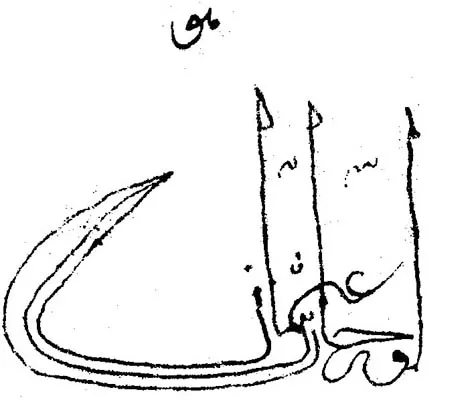
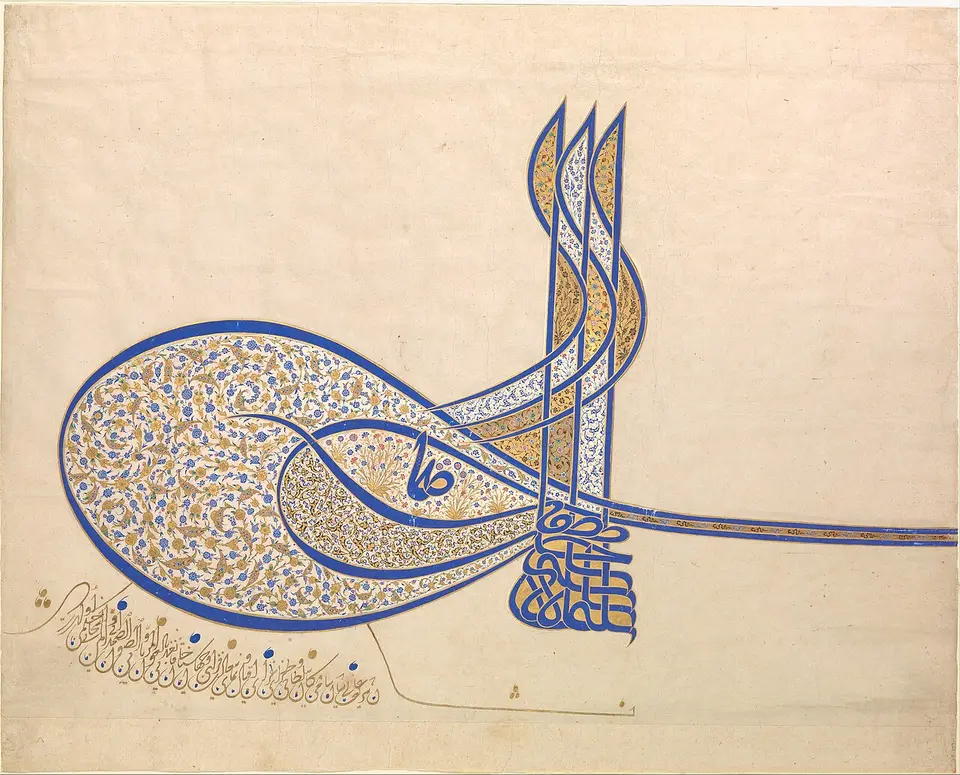
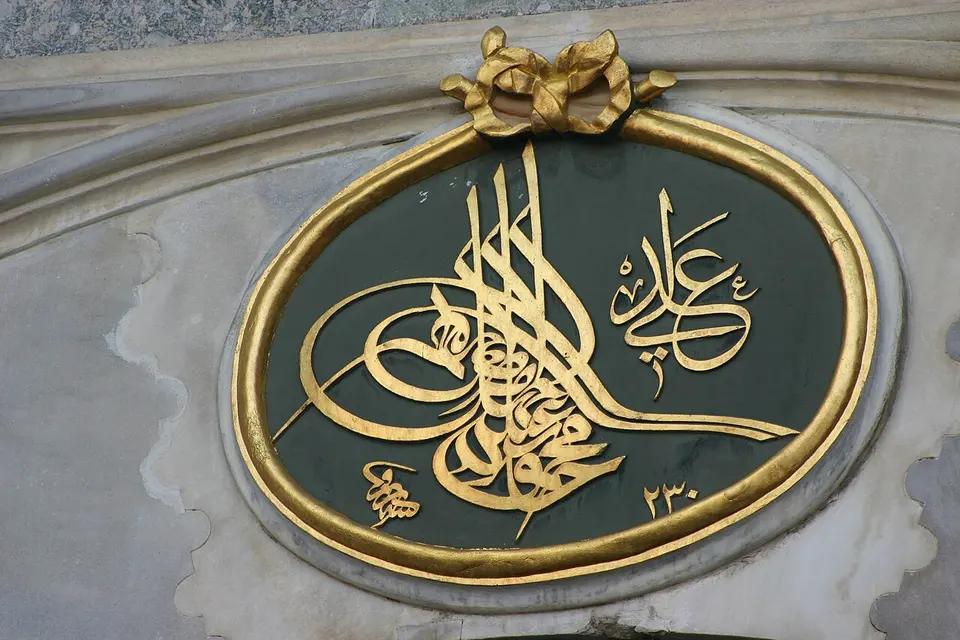
Anatomy of a tughra
Mahmud II’s tughra, which reads “Mahmud Han bin Abdülhamid, el-muzaffer dâimâ”, with its parts numbered, and what each part becomes in Orkhon runes.
| # | Part |
|---|---|
| 1 | Serekürsü, tahtOttomanThe base: the sultan’s name and his father’s, with şah and han, stacked in one block.RunicThe name in Orkhon runes, right to left, in one row or with the surname stacked below. |
| 2 | TuğelifOttomanThree tall shafts rising from the sere, drawn from the name’s alifs. Always three, however many alifs the name has.RunicUp to three letters of each word with an upright stem grow tall; the surname’s shafts are shorter. |
| 3 | ZülfeOttomanThe curls that fall from the tops of the tuğs, like pennants in the wind.RunicThe standard on each shaft: pennant, swallowtail, streamer, horsetail, three pennants or a heptagon finial. |
| 4 | Beyzeinner and outerOttomanTwo nested loops sweeping left, made from the n’s of bin and han.RunicA heptagon, seven being sacred in Turkic tradition, with its left edges doubled for the two loops. |
| 5 | KolhançerOttomanThe loops’ extension: two parallel lines reaching right like a blade.RunicArms grown from the name’s first letter, in eleven forms: arrows, a bow, a sword, the Big Dipper and more. |
| 6 | DuaOttomanThe prayer el-muzaffer dâimâ, “ever victorious”: muzaffer is the knot at the heart and the thin stroke sweeping left through the loops; dâimâ, “always”, is the small figure inside the inner beyze.RunicInside the heptagon, 𐰋𐰀𐰭𐰏𐰇 bengü, “eternal”: the word the Orkhon stelae use for themselves, bengü taş. |
| 7 | MahlasOttomanA second name or epithet at the upper right, a custom begun by the calligrapher Mustafa Râkım: Mahmud II’s ʿAdlî, on the Topkapı gate above. Not in this drawing.RunicAn optional word of your own, in small runes at the upper right. |
The script
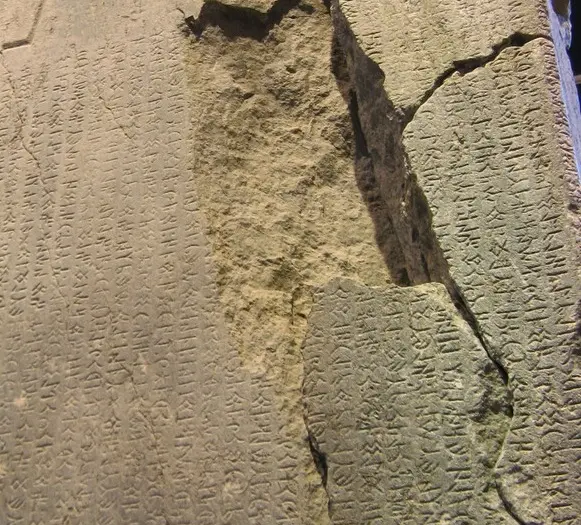
The Orkhon script is the alphabet of the Göktürks, the oldest known script made for a Turkic language. It is written right to left, its letters never join, and words are divided by two dots (⁚). Its straight, angular letters were made to be cut into stone, which is why it is often called runic.
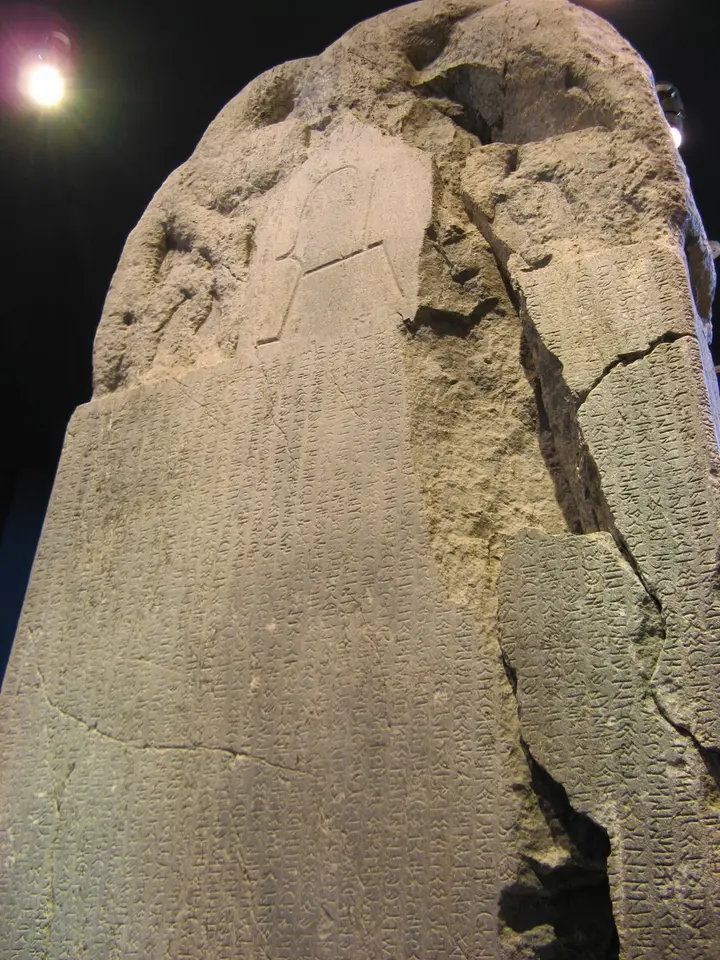
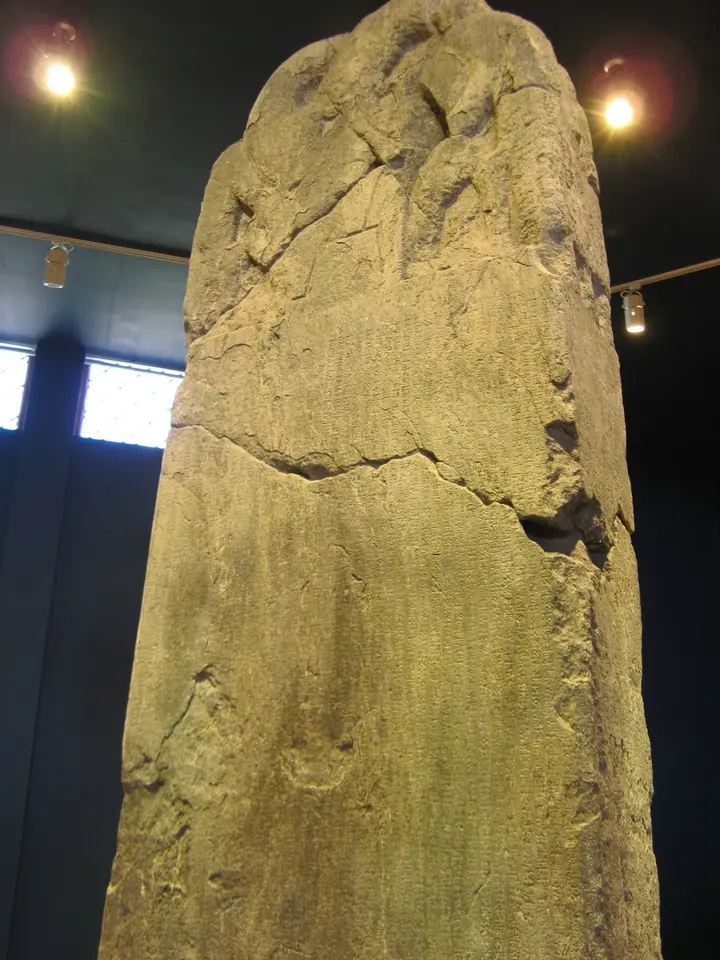
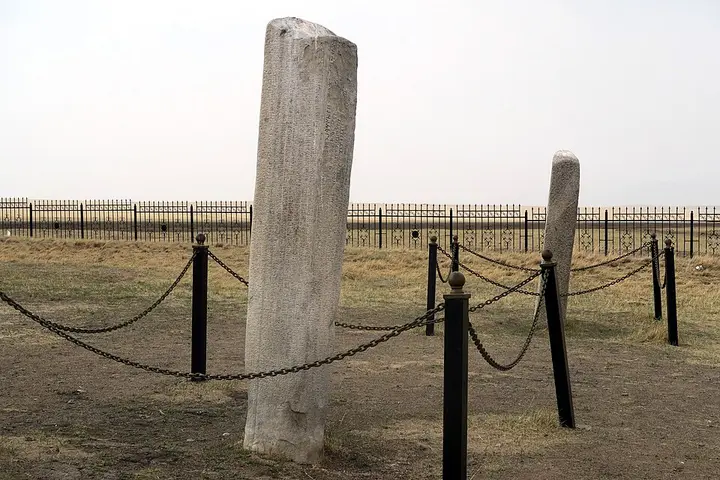
It is named after the Orkhon Valley in Mongolia, where it survives on great memorial stelae. Bilge Kağan raised one in 732 for his brother, the prince Kül Tigin, and his own followed in 735, a year after his death. A little earlier, around 716, the statesman Tonyukuk had his deeds carved further east. In an epic voice the texts tell the origins of the Turks, their years under Tang China and their rise again, and speak directly to the Turkic people.
Nikolai Yadrintsev’s expedition found the stelae in 1889, and the Danish linguist Vilhelm Thomsen deciphered the script in 1893. The Kül Tigin and Bilge Kağan stones now stand at Khöshöö Tsaidam, part of the Orkhon Valley World Heritage Site.
The alphabet
Four vowel signs stand for eight vowels: 𐰀 a/e, 𐰃 ı/i, 𐰆 o/u and 𐰇 ö/ü. Instead, most consonants come in two forms, one for back vowels (a ı o u) and one for front vowels (e i ö ü), so the consonants carry the vowel harmony. k has five signs that also say which vowel it sits with.
The inscriptions leave most vowels unwritten: a and e only appear at the end of a word, other vowels in the first syllable or at the end. That is the historical spelling. Because it is hard to read back, the maker writes every vowel by default.
Old Turkic had no c, f, h, j, v, w or x. The maker uses the nearest sound: c and j as ç, f as p, v as b, h as k, w with the o/u sign, x as ks. English is spelled letter by letter, with sh, ch, th, ph, ck and qu read as one sound, not by pronunciation. This is a modern adaptation: the Göktürks never wrote these names.
Vowels
Four signs for eight vowels.
- 𐰀a / ea or e
- 𐰃ı / iı or i
- 𐰆o / uo or u
- 𐰇ö / üö or ü
Consonants in pairs
One form beside back vowels, another beside front vowels.
| Sound | With a ı o u | With e i ö ü |
|---|---|---|
| b | 𐰉b¹ | 𐰋b² |
| d | 𐰑d¹ | 𐰓d² |
| g, ğ | 𐰍γ¹ | 𐰏g² |
| l | 𐰞l¹ | 𐰠l² |
| n | 𐰣n¹ | 𐰤n² |
| r | 𐰺r¹ | 𐰼r² |
| s | 𐰽s¹ | 𐰾s² |
| t | 𐱃t¹ | 𐱅t² |
| y | 𐰖y¹ | 𐰘y² |
Five k’s
Each also says which vowel stands beside it.
- 𐰴qk, with a
- 𐰶ıqk, with ı
- 𐰸oq / uqk, with o or u
- 𐰚kk, with e or i
- 𐰜ök / ükk, after ö or ü
One form
Used with every vowel.
- 𐰲čç
- 𐰢mm
- 𐰯pp
- 𐱁šş
- 𐰔zz
- 𐰭ŋng (as in Tengri)
Ligatures
One sign for two sounds; the maker uses them in historical spelling.
- 𐰦nt / ndnt or nd
- 𐰨nčnç
- 𐰪ñ / nyny
- 𐰡lt / ldlt or ld